Why there is likely to be a Covid-19 second wave: lessons from the Spanish Flu

In the second of two articles looking at the potential impact of the Covid-19 crisis by looking at historical parallels and seeing what lessons can be learned from history, we look at the ways in which pandemics spread and what lessons can be drawn from historical pandemics.

The Spanish Flu of 1918-19 was the deadliest influenza pandemic in history and one of the most deadly pandemics ever. It infected an estimated 500 million people across the planet) which represented about 1/3 of the total population) and estimates of the death toll are between 17 million and 50 million.

One of the characteristics of the Spanish Flu pandemic was its multiple waves (see below) and this is a feature of many flu-like pandemics – as can be seen in the 2009 influenza pandemic.
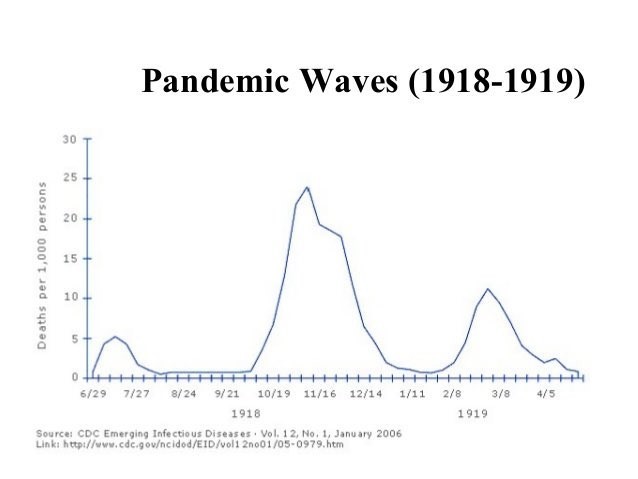
Spanish Flu first appeared in March 1918 and at the time, many people thought that it was very similar to a seasonal flu – whilst it did spread quickly through Europe, the mortality rate initially seemed similar to seasonal flu (around 0.1%). After an initial spike in the infections and fatalities in June and July 1918, the spread of the virus appeared to have slowed down and, by September 1918, everyone thought that this flu had simply run its course.

What happened next took everyone by surprise, with a huge surge in both infections and deaths which started in October and peaked in November 1918. The reasons for this are not fully understood, but the large troop movements around the world at the end of the First World War does seem to have played a major role in the disease spreading so quickly. The virus also seemed to mutate to a deadlier form and went from a disease with a fatality rate of around 0.1% to one between 2 and 10% – nearly one hundred times as fatal. It is worrying to note that the second wave killed many more people than the first wave did.

There is some debate around the exact mortality rate – partly because the science of epidemiology was still in its infancy and death certificate recording was fairly inconsistent. The public health response in 1918 was very similar to the public health response today, and in some countries people were told to socially isolate, told to stay indoors and there were widespread restrictions on public transport and businesses. In parts of the USA, people were fined for not wearing face masks and public gatherings were enforced by the police. There was also political disagreement regarding the trade-off between public health and the economic impact of social restrictions. It is reported that Dr. Arthur Newsholme (the chief medical officer for the Local Government Board, and the person primarily responsible for public health in England and Wales) allegedly knew that a strict civilian lockdown would save lives, but refused to order this as he was concerned about the impact on munitions factories and the war effort.

In the face of no curative solution, medical misinformation was in wide circulation and some doctors were advising patients to take 30 grams per day of Aspirin which a dose we now know to be fatal.

Despite strong government guidance and social action, a subsequent third wave of the Spanish Flu occurred – which killed even more people than the first wave. Current modelling has tried to decipher why the subsequent waves were more fatal and there is some evidence that this may have been because of acquired immunity. There is evidence that this may be because of behaviour change in the population at large. There is also some evidence that the mortality rate was much higher in urban areas and cities and that this was around 40% higher than in rural areas.

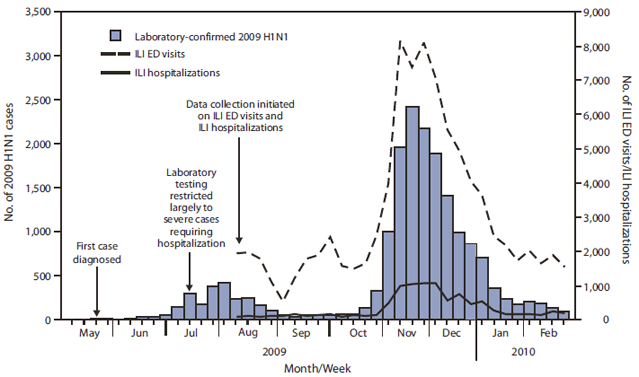
This is not simply a curiosity of the 1918-19 Spanish Flu and similar waves were also seen in the 2009 Flu Pandemic and the second wave there was also more deadly than the first wave.
So, what does this all mean in the context of the current Covid-19 Pandemic?

It certainly seems that there is a high likelihood of a second wave, and that the death rate is likely to be higher than that of the first wave. Many of the same public health measures are used today as were used in and 2009 – although arguably these are currently enforced much more vigorously. There has even been a brief second co-vid wave in Japan, with the second wave hitting 26 days after the first state of emergency was lifted. Professor Kenji Shibuya of King’s College London said of the second outbreak that “The key lesson is even if you are successful in containment locally but there is transmission going on in other parts of the country, as long as people are moving around, it’s difficult to maintain a virus-free status”.

The peak of the second wave in both 1918 and in 2009 were around 4 months later than the peak of the first wave and the second waves lasted around 3 months. If the same pattern happens in 2020 then a second peak would be expected in the UK in September 2020 and would last until November 2020. It is entirely possible that this could coincide with a seasonal flu outbreak which also happened in 1918 and 2009.

The main takeaway from this analysis is that we should not assume that the worst of the Covid-19 infections are behind us simply because we are beginning to see a tailing off of infections and fatalities. Both of the mentioned pandemics happened in the past, and both were followed by second waves which were more virulent and fatal. The social distancing and lockdown measures currently practiced will help, but these measures should not be seen as sufficient in and of themselves. We should at the very least prepare for a late autumn resurgence in infections and death and ensure that this is factored into our planning and our preparedness.
Covid-19: lessons from the Great Depression

This is the first of two articles looking at the potential impact of the Covid-19 crisis by looking at historical parallels and seeing what lessons can be learned from history. This article looks at the economic impact and what lessons can be drawn from historical UK recessions.

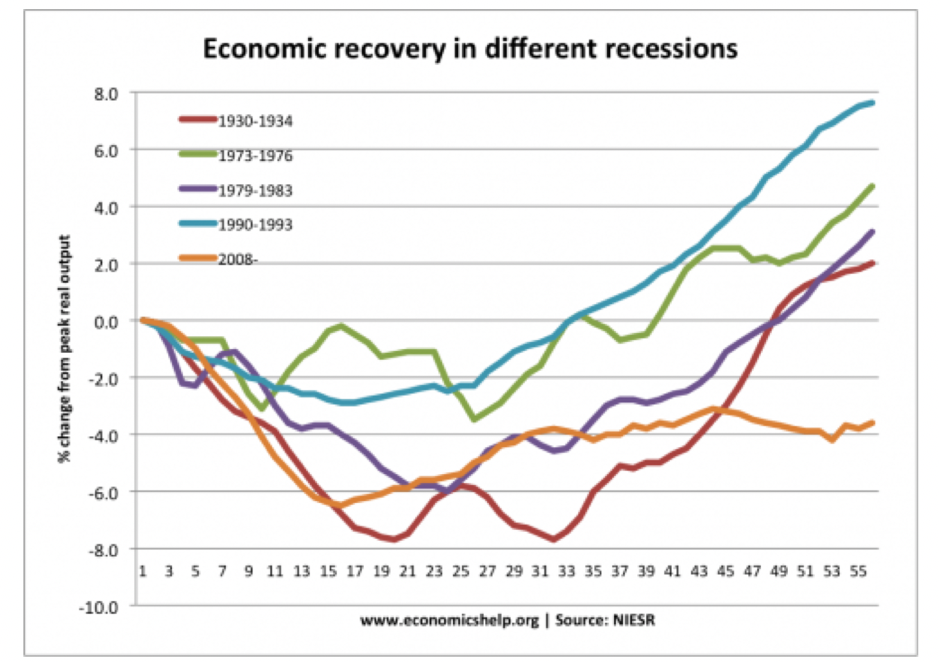
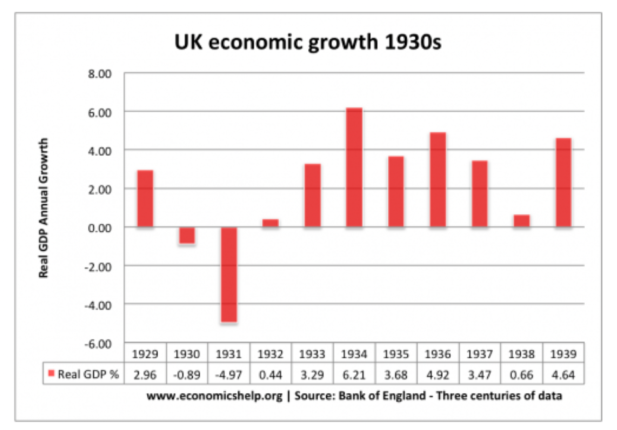
What is now beyond doubt is that the current Covid-19 crisis will trigger a recession as this is defined by two-quarters of negative growth. The latest Bank of England forecast shows that the UK economy will shrink by around 14% this year. To put this in context, the Housing crisis of 2008 only shrank the economy by around 2.5% but we have still not fully recovered from it. The scale of the forthcoming recession is liable to be much closer to (and perhaps larger than) the Great Depression of the 1930s which only saw the UK economy shrink by around 5%.

So if we are heading towards a recession that is potentially similar in scale to the Great Depression, what can we learn from how that impacted the economy, particularly in health and social care.

Length of the Great Depression

The Great Depression had 2 peaks (or troughs) approximately 20 months and 33 months after the start. Even the recession of the 2008 Housing Crisis peaked (or troughed) around 15 months after the start.

The UK economy did not recover to its original starting point in the Great Depression for 48 months and the economy has still not recovered to its starting point from the 2008 Housing Crisis even though that was 12 years ago.

Optimistic scenarios that suggest the UK economy will simply “bounce back” later in 2020 are simply not borne out by history. It seems much more likely that the upcoming recession will peak in late 2021 or possibly even late 2022.

Impact on unemployment

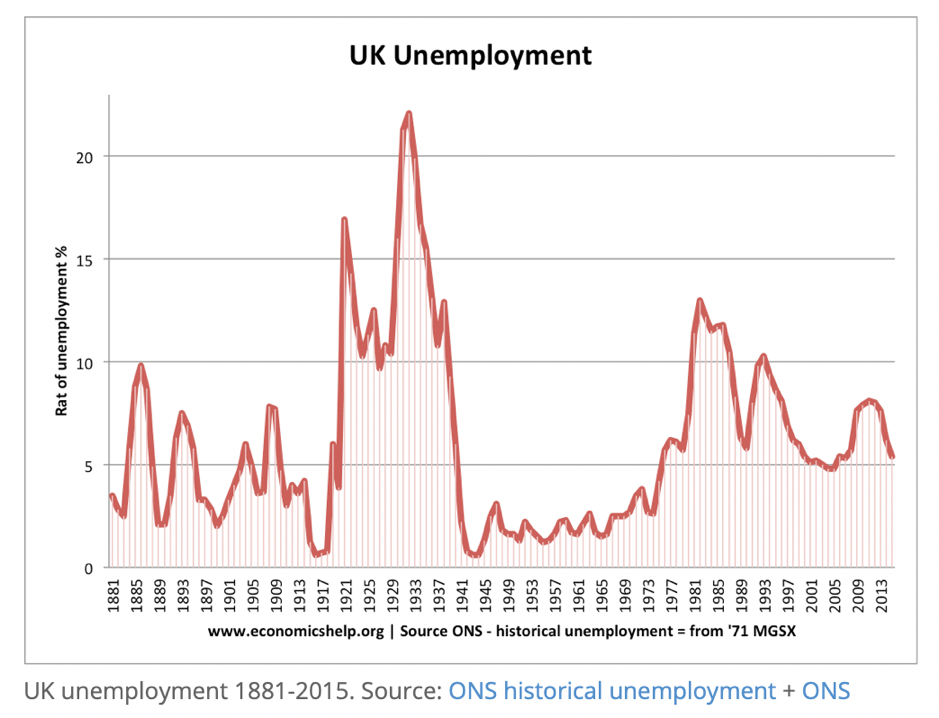
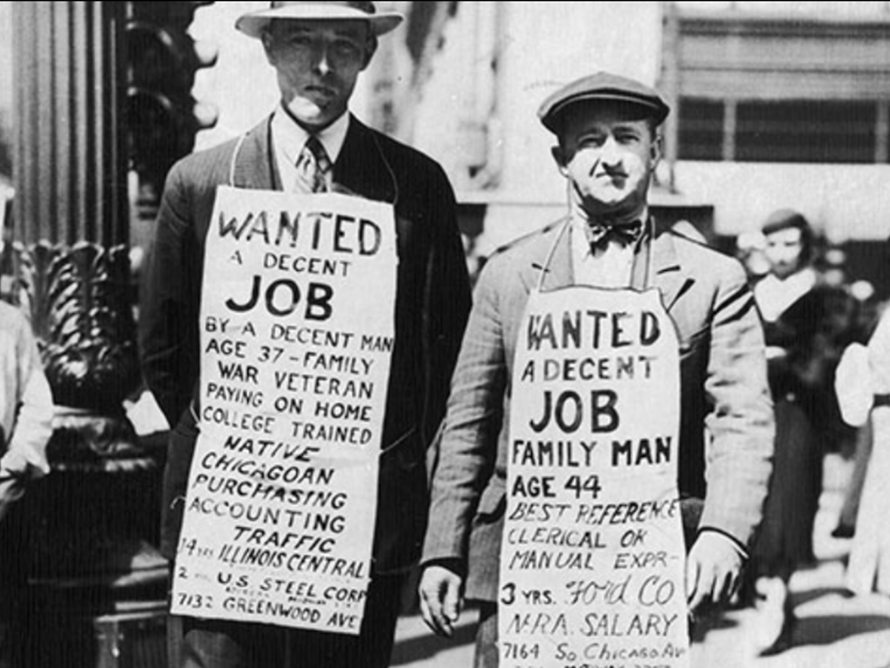
The impact on unemployment was significant in all recessions but the impact of the Great Depression was particularly significant. The peak unemployment rate for the whole UK was around 23% although this was not evenly distributed across the country. London and the South East had peak unemployment rates of around 13.5% but in the North of England, Scotland, Wales and Northern Ireland there were rates as high as 70%.

It is difficult to compare economies too much across the decades as so much has changed but the worst unemployment rates during my lifetime were in the 1980s under Margaret Thatcher’s Conservative Government where the national rates were around 13% and over 3 million adults were unemployed. The unemployment rate during the Great Depression was double that so it is not inconceivable that the upcoming recession might also generate average national rates of unemployment in the mid 20% range with perhaps 6 million adults being unemployed. The Office for Budgetary Responsibility has already increased its projection for the unemployment rate in 2020 to be as high as 10%.

Whilst much has changed, the relative economic position of London and the South East relative to the North of England, Scotland, wales and Northern Ireland hasn’t changed so again we would expect this to hit these areas disproportionately hard and to last disproportionately longer. One of the areas hardest hit was the town of Jarrow, where unemployment was the primary driver behind the famous Jarrow March, where unemployed workers marched 300 miles to London to protest.

Impact on the welfare state

Although the welfare state of the 1930s is not as comprehensive as it is today, there was a form of unemployment benefit designed to provide a basic safety net for the poorest and most vulnerable in society. Interestingly it was the perceived failure of the welfare state system in 1932 that led to the creation of a Royal Commission on Unemployment and the subsequent Unemployment Act of 1934.

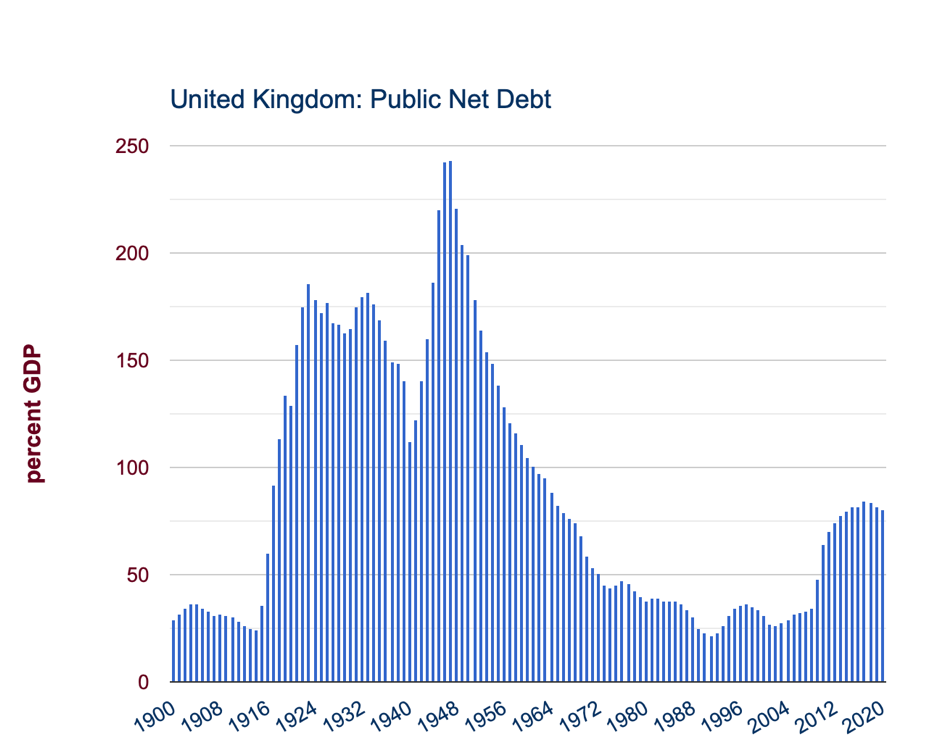
There was though huge political pressure to reduce expenditure on unemployment benefit as the level of state debt was around 180% of the UK’s Gross Domestic product (GDP). The latest projections from the Office for Budget Responsibility suggest that the projected level of borrowing could be £298bn which would be much higher than the peak of £150bn during the 2008 Housing Crisis.

If the level of Public Debt reached the sort of levels that the UK hit during the Great Recession then this would be more than double the impact of the Housing Crisis and the impact of that on the welfare state (the policies of “austerity”) can still be felt today more than 12 years on.

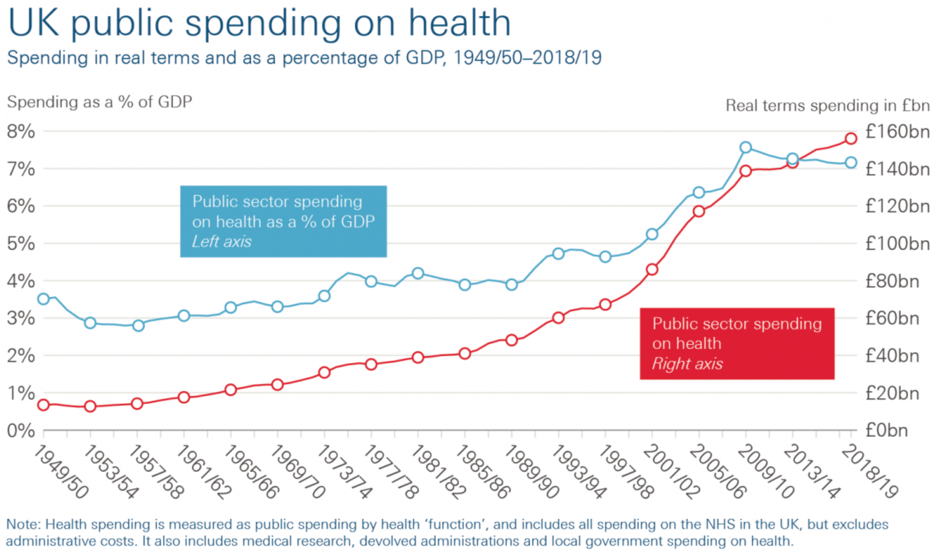
There is a very strong argument that the welfare state and particularly the NHS and social care have been underinvested in over the last decade and the Health Foundation’s analysis showed that UK spending on health as a percentage of GDP has fallen since 2008 and the beginning of austerity.

If the pressure on public spending is much greater than that experienced in 2008 then it seems likely that there will be simultaneous downward pressure on NHS and social care budgets at a time when demand may surge. We know that NHS Englandare predicting significant increases in demand and we still don’t know what the impact will be of the delayed treatments during the peak of the current crisis. It is worth recognizing that demand predictions are notoriously complicated though and although we know people haven’t been going to GPs, A&Es, hospitals for a few months, equally many elderly people are dying who may well have likely to have been significant users of services.

Whether the exact shape of the current recession ends up closer to the Great Depression or the Housing Crisis or some other pattern is hard to predict but the GDP reduction and the unemployment rates are both already predicted to be much greater than the Housing Crisis of 2008 and may be of the same scale as the Great Depression. Whilst the reaction to economic depressions is ultimately a political and economics choice, the context looks very likely to be a recession that will hit twice as hard as the 2008 Housing Crisis, last 2 to 3 years, generate levels of unemployment around twice that of the 1980s and be associated with a huge pressure on public sector spending.

In the second article, I will be looking at the lessons we may be able to draw from previous pandemics.

How to give up your day job

I get asked this a lot at the moment and I think its probably a sad indictment of the state of morale with many nurses. Often people have a great idea for a service or a new social enterprise but don’t know when the right time is to leave. From my experience over the last 5 years, I think there are 3 distinct phases you need to move through and (for the record) I completely botched this myself and survived the first year by the skin of my teeth.

Stage 1 – The planning stage (still with your current employer)

The 1st stage needs to be complete before you do anything about leaving. First you need to work out your business idea and by that I mean the idea or service AND a way that this can be run at a surplus. Often people have a great idea but haven’t worked out how much it will cost to run, where the income will come from and the “napkin costings”. Once you have a business idea then you need to develop contacts with commissioners and potential purchasers and look to raise the start-up income. You may even be able to start delivering the work at this stage even though you are still holding down a full-time day job.

Stage 2 – Early growth (part-time with your existing employer)

This stage starts when the new enterprise can pay AT LEAST half your current salary. Until you have brought in half your salary then you are still at stage 1 and it is incredibly risky leaving your job while you are in stage 1. Once you have enough income to support yourself on a part-time job then you need to start negotiating with your current employer about moving to a part-time role. Tim Ferris has some very detailed strategies for this stage in his book “The four-hour workweek” and I can heartily recommend this to anyone at this stage. This transition can be tricky and you need to carefully think through a number of issues such as conflicts of interest, indemnity insurance, workload balance between the two roles, work-life balance, etc.

Stage 3 – Full-time entrepreneur

You can move to this stage when your new enterprise can pay AT LEAST your full-time salary. A reserve of 3-months salary is the bank is ideal but it needs to be able to complete support you. At this point, you should hand in your notice and it is possible to waive your contract’s notice period if both you and your employer are happy to do this. One of the other possibilities at this stage is for your new enterprise to second you from your current employer although you will definitely need advice if you are looking at this route. The big advantage of this is that you may be able to keep your pension and it may be slightly less risky than being a full-time entrepreneur (although if you are that risk-averse, being an entrepreneur may not be a very comfortable existence).

The key to this process is that it is not dependent on your personal aspiration, your current work situation or how good your business idea. The stage you are at is ENTIRELY BASEDon how successful your enterprise is. Given that 50% of new enterprises fail within 4 years, it is also a way of testing how good the idea is and whether it can financially support yourself without risking everything on it. If you leave prematurely and the enterprise is not as successful as you hoped (or even if you hit the dreaded cash-flow problems) then you may end up taking on personal debt in order to survive as the enterprise cannot afford to maintain you.

It is also easier to grow your market, do your business planning, make business contacts without the enormous pressure of wondering where this months mortgage payments are coming from or shopping for Netto’s no-frills baked beans and wondering what exactly were the frills in a tin of beans.

How the EPOCH business model can increase your turnover

What I am about to describe is the EPOCH model which is freely available for you to use under our creative commons licence. It is free so if I doesn’t work you won’t get any cash but I will give you your time back, maybe by coming round and doing some gardening or cleaning your car or sorting out your web page 🙂

First of all, the EPOCH model is a 5-stage process to help your thinking and discussion and understand your current earnings potential as well as possible new income streams. You can work through this on your own, you can work through this with your board, you can involve staff, users and stakeholders and you can even ask someone like me to come along and facilitate it.

The EPOCH model asks 5 questions and each question feeds into the subsequent question. The 5 questions are:

E – What are you EXCELLENT at?
P – What PEOPLE could benefit from you doing the things you are excellent at?
O – What are the OUTCOMES on the people who are you are doing your excellent thing to?
C – Who would COMMISSION you for these outcomes?
H – HOW MUCH would these commissioners pay for these outcomes?

So let’s go through these one step at a time.

Step one is E – What are you EXCELLENT at?

This is often a hard one for people. They know what they do and what they want to do but have never really given much thought to what they are excellent at. Let’s say you run a community café – is your food or drink excellent? By which I mean is it much better than your competitors? Could I come along and easily replicate what you do? If the answer is yes – you are in trouble. If I can come along and replicate it to the same quality then you can only really compete on price and you are going to spend the rest of your life cost-cutting, penny-pinching and trying to undercut your opposition. That isn’t a life! If that’s all you can do, jack it all in now, sell your car, buy a one-way flight to a tropical beach and spend the rest of your days sipping rum from the bellybuttons of Nepalese madiens – it will be far far more rewarding.

The other issue is that what you are excellent at may not be what you are currently doing. You may have real talent as a facilitator, or a chef, or a trainer or a gardener and you may work in the accounts department. Your excellence is often in the areas of your passion and spending time doing what you are really excellent and passionate at is the beginning of real personal happiness as well as business success. So think of the whole organisation as well as the people within it and tease out the areas of real passion that you are really good at and crucially better than your current and future competitors.

Most organisations and people I have worked with can tease out at least 5 things they are excellent at – keep going until you have at least 5 (but the more the merrier).

Step two is “P – What PEOPLE could benefit from you doing the things you ?”

Don’t think of this as the people who are you are currently delivering services to but much much wider. If you are excellent at gardening, who could benefit from someone being excellent at gardening? People with gardens, businesses with gardens, housing associations with open spaces, parks, the National Trust, companies who sell gardening equipment, people who want to develop compost heaps in their garden, colleges looking to train people at gardening, organisations looking for outdoor work placements, nursing homes, sheltered housing, hospitals, etc.

You should be able to come up with AT LEAST 10 groups of people or organisations who could potentially benefit from EACH thing you are excellent at. So now you should have at least 5 things you are excellent at and at least 50 groups of people or organisations that you could benefit.

Step three is “What are the OUTCOMES on the people who are you are doing your excellent thing to?”

So for each group of people or organisations that you have identified, you need to work out the outcome you have on them. Again many people find this really hard as they are so used to describing their processes and being commissioned for their processes.

Let’s take the gardening example again and work through some of the people and organisations we identified earlier:

  • What would the outcome be of us providing gardening for people with gardens? Well a neat and tidy garden would be an obvious one. If you worked alongside the people themselves you could also increase their fitness by providing gentle (or vigorous) activity.
  • What would the outcome be for businesses with gardens? A more professional image for their organisation might be one. Providing work for local people or local social enterprises could be another (under their corporate social responsibility programme).
  • What would the outcome be for housing associations with open spaces? A more professional image could be one. Increased local resident satisfaction could be another. Winning additional contracts (based on their environment and appearance) could be a third. Providing a compost facility (maybe with a food recyclying scheme) could be a fourth.

Now we could go on, but already we have identified the following outcomes that you could achieve. And if this is an area that you are genuinely excellent at, then you could achieve the following outcomes BETTER THAN OTHER ORGANISATIONS CAN:

  • a neat and tidy garden 
  • an increase in fitness by providing gentle (or vigorous) activity.
  • a more professional image for a business
  • providing work for local people 
  • a more professional image for a housing association
  • increased local resident satisfaction 
  • additional contracts (based on their environment and appearance
  • providing a compost facility (maybe with a food recyclying scheme) 

If you work through all 50 people and organisations from step 2, you should now have over 100 possible outcomes that you can deliver.

Step four is “Who would COMMISSION you for these outcomes?”

Now the key here is to work out who would be interested in the outcomes from step 3. Again we will work through some of the gardening examples:

  • Who would be interested in paying for a neat and tidy garden? Well the public themselves would be one. Possibly the relatives or carers of elderly people might be another.
  • Who would be interested in an increase in fitness by providing gentle (or vigorous) activity? Again the public themselves. Also local general practitioners might be interested. Maybe other organisations such as Age Concern.
  • Who would be interested in a more professional image for their business? Business owners could be one. Estate departments might be another. Possibly the local Council.
  • Who would be interested in providing work for local people? Local businesses might be interested as well as public sector bodies such as Job centres, New Deal for Communities, local Councils, etc.
  • Who might be interested in a more professional image for a housing association? Housing associations would be an obvious one. Perhaps also a national or regional network of housing associations could be interested in providing this for their members.

If step 3 provided over 100 outcomes, you should now have developed over 150 potential customers who would be interested in buying outcomes that you can deliver BETTER THAN YOUR COMPETITORS. These are 150 potential businesses and 150 potential income streams (and possibly several hundred if you are being really creative).

Step five is “H – HOW MUCH would these commissioners pay for these outcomes?”

This is where you have to do some market research and will involve time in the library, time ringing up competitor organisations and time on the web (proper time on the web mind – not levelling up your Night-elf Druid on World of Warcraft!).
Again I will work through a few gardening ones and at this stage you should have 150 to work through:

  • What is the going rate to maintain a neat and tidy garden?
  • What do people pay to increase their fitness?
  • What would GPs pay to keep frail elderly people active?
  • What would a local business pay to maintain a professional image?
  • What would the local Job centre pay to provide meaningful and sustained employment for someone on long-term benefit?
  • What would a local housing association pay to increase resident satisfaction?

Notice that in all of these, you are not selling gardening. If you try and sell gardening then you are limited to daily rates and people focus on the process not the outcome. You are selling a neat and tidy garden, fitness, keeping the elderly active, sustained employment, resident satisfaction, etc. Gardening is simply the route to the outcome but you are selling the outcome. If it is worth £5,000 for someone to be given a sustainable and meaningful job then that is the value of what you do and this is often significantly more than the hourly or daily rate of your process.

So now you should have over 150 potential income streams and the value of each of those income streams.

So what’s next?

Well this is where you sit down as a board, a management group or with your members and decide which of these business you want to explore. You should be able to compete in these because the starting point is your excellence, i.e. what you are better than your competitors at. Which business you choose to move into is as much about your values, your ethos and your mission as it is about income and profits – or at least it should be if you are a social enterprise and now you have a whole heap of possibilities to discuss, debate and mull over (preferably over food and almost definitely with glass or two of wine).

How to present for funding

I am not going to write about generic presentation skills here but presentations that are specifically designed to get someone to give you money. That could be a contract, a sale, a loan, venture capital, a grant, etc. The one thing all of these types of presentation have in common is that at the end, you want someone to give you money. Applause is nice, laughter can be good, even warm appreciating smiles can make you feel successful but unless you walk out of the room with a big wodge of cash, your presentation failed. The purpose of these presentations is to get money and whether you get money at the end is the only outcome in town.

I don’t know when I first got really interested in the science and art of presenting but it has been something I have been passionate about for at least a decade. I suppose that is how I fell into teaching other people presentation skills and so I have seen hundreds of people present at conferences, workshops and when they are bidding for contracts. There seems to be some sort of implicit assumption that presentations for contracts or funding are essentially the same as presenting at conferences, workshops, seminars, etc and I think this is completely wrong.

So before I give you a few pointers, let me talk about the 5 worst mistakes that people make when they are presenting for funding. I have seen all these mistakes in action as a commissioner, member of judging panels and as outside observer and they always make my heart sink.

The 5 worst howlers:

1) Presenting too much information

This is the most common mistake and one of the most deadly. Dave’s law on presentation skills states that “THE LONGER YOU WORK ON YOUR PRESENTATION, THE WORSE IT WILL BE”. After seeing literally hundreds of presentations over the last few years, I have seen very very few exceptions to this rule. The reasons are quite simple – the longer you have to work on a presentation, the more stuff you will try and put into it. My heart sinks when I see slide after slide full of bullet points and text. What people don’t realise is that the only important thing in a presentation is what people can remember an hour or two later (usually when they are deciding what to fund). They will remember 4 or 5 things about your presentation at best, so if you presented 30 ideas using 400 words, they will forget 80-90% of what you told them. All those words and ideas have ended up in a psychic bin – if it isn’t in their memory, it was a complete waste of air.

Now if you turn that on it’s head and think I want them to remember 5 things and these are the 5 things, then you can present those 5 things really well. Tell a story. Use some really big graphics. Do a presentation with only 5 sentences or even better 5 words. Merlyn Mann (One of my productivity heroes) has a style of presenting based on Guy Kawasaki’s approach where you use large images and a few words. He coined the famous 10-20-30 rule, in that a presentation should have a maximum of 10 slides, last a maximum of 20 minutes and all the fonts should be at least 30pt. Blow them away with your 5 really well-made impact-filled points or ideas and leave them wanting more information (not wondering how many more slides they have to sit through).

2) Not understanding the people you are presenting to

What do they people you are presenting to REALLY want? Not what you think they want but what really drives them? What do they get excited by? What are their biggest problems? What have they spent their professional lives working for?

If you see the people you are presenting as simply “managers” and think that all they are in interested in is money, your presentation is very likely to fail. Recently I sat through a presentation as a panel member when someone tried to present to me what social enterprises really are and how we really didn’t understand their needs. 30 seconds on Google will have told him that I have spent the last 5 years running social enterprises and that that is not a great presentation tack to take with me.

If you don’t know who the panel are, what drives them, what the biggest problems they face and what they want from you then you shouldn’t even be standing in front of them. If you do know these things then what you can do is present your proposal as a SOLUTION TO THEIR PROBLEMS, using stories that you will know they are interested in and as a way of making their lives easier and making them look impressive to their bosses and peers.

3) Leaving what you want till last

This is a subtler mistake and is where presentations for money differ dramatically from “teaching” presentations. If you are trying to teach someone something, then you usually start with a background or context, then build up a narrative and end with a conclusion. If you are presenting for money, you need to tell them what you want FIRST.

Have you ever had one of those cold-callers at home in the evening that starts off asking how you are and how your day was? If your brain is anything like mine, you are thinking all the time “what do you want”? Until I realise what it is they want, I am going to frame everything the say from the viewpoint of trying to find out what they want.

A typical presentation often goes like this:

Hello, I am here to talk to you about Glossophobia (look it up on Wikipedia).

The panel think “how much money do you want”?

We have been working in the field of Glossophobia for 17 years (“how much money do you want”?)

Our track record is ……. (“how much money do you want”?)

Our proposal is …… (“how much money do you want”?)

In conclusion, we want £30,000 for this project. The panel members now think “£30,000 to address Glossophobia – that sounds reasonable”. Now what is the idea again?

Until you tell them how much you want and they make a mental calculation of whether or not that is even sensible, they will take in almost no other information. So start with it. Your opening slide should be “We want £30,000 to address Glossophobia”. Assuming that the panel think this is reasonable, they will now be intently interested in what your solution is and actually paying attention.

4) Trying to sound the way you think business people should

This is a particularly common issue with nurses for some strange reason. It is almost as if they have an image in their head of what business managers should sound like and then try and do a really bad impression. When they start using management jargon and business-speak they often sound very unconvincing. Some of the most powerful presentations I have ever seen (and which won contracts) often focused on patient stories and community anecdotes that brought the idea and the proposal to life.

The people you are presenting to won’t know the community or group you are working with as well as you, or understand clinical care as well as you, so bring it to life for them. Let them see it through your eyes and try and express your passion to them. It is an area where you know much much more than they do and you can communicate that with real passion and sparkle.

5) Not knowing your finance

My son wouldn’t watch Dragon’s Den with me in the room because he was sick of me yelling at the telly (and scaring the puppy). Everytime I see a budding entrepreneur who doesn’t know their turnover, or doesn’t know their last year’s profit or their sales target for next year, I really get cross. I have never met a serious entrepreneur (social or otherwise) who didn’t know last year’s turnover and profit and have a pretty good idea what this year’s would be.

If you are bidding for funding, you need to know the financials in your proposal and they have to be realistic. I can spot a padded bid a mile off and so can most funders. If the project costs £15,000 then ask for £15,000 and defend your costs. Don’t try and bump it up to £50,000 because that is how much money they have or you will look ridiculous (or worse a liar). I tell people this all the time and they still present costings you can drive a coach and horses through.

I can guarantee that if I am offering £25,000 then nearly all the bids will be for about £25,000. If I was offering a £100,000 then EXACTLY THE SAME BIDS would come in for £100,000.

So two quick pointers:

A) forget the bid amount and work out what you actually need to do your project. If you pitch for exactly that (especially if it is a lot less than they are offering), you stand a really good chance of being funded and you will stand out from the crowd.

B) Any cost with three zeros at the end looks suspicious and any with four zeros at the end is made up. Nothing costs £10,000. If you don’t know what it really costs and think it is around ten thousand then at least put some random numbers in it. Say 3 …. errr …. 7 ….. errr 4. So now I am going to ask for £9,374. It just sounds believable. If you ask for £10,000 they will think your pitching and will try and knock you down to say £9,000. If you say it will cost £9,374 (equally made up figure) they will assume that you have very detailed and precise costings.

So in summary:

1) Present 4 or 5 ideas and present them well
2) Don’t overprepare the presentation
3) Tell them what you want first
4) Sound authentic and talk about what you know and what you are passionate about
5) Find out what they want, what their problems are and who they really are
6) Know your costings

Creating innovation from failure

Everybody recognizes that failure plays is an important role in innovation but there is a lack of structured advice about how to encourage and use failure in a practical way. Below are some thoughts about how failure can be used in a practical way:

1) Remove the stigma from the word failure Failure is a word that has a lot of negative connotations and is a word that many people are uncomfortable using. In a recent interview I asked applicants “what was their greatest failure” and many replied that they did not like the word and did not associate anything they did with failure. If conversely I had asked “when have you ever tried anything new”, none of them would reply “I have never tried anything new in my life”. And yet this is precisely what they are saying by saying they never failed. Nothing is ever achieved successfully on it’s first attempt so any attempt to try or learn anything new will involve some failures along the way. We need to reclaim the word and recognize it’s importance as a developmental step.

2) Encourage the sharing of failure If you are trying to encourage innovation, there will inevitably be failures along the way. By encouraging people to talk about it and to share their stories of failure, the group or organization as a whole can learn much faster. If the same mistakes are being repeated over and over again in isolation, it makes the learning process much harder and much slower. The sharing of failure needs to be seen as an important contribution to the success of the group and the success of the organisation.

3) Fail often and fail small Where failures become catastrophic, they are often very large failures and can result in the destruction of an organization (e.g. Barings Bank, NHS University, etc). Even when the organization survives, a catastrophic failure can seriously damage an organization’s reputation (e.g. BP, Nasa, etc). The trick is to iterate quickly so that any failures happen quickly and at a small level. By encouraging experimentation and innovation at a small scale, the lessons can be learned before significant resources are invested.

4) Make failure survivable for the person and the organisation Linked to the previous point, the board and management team of an organization need to make sure that failures do not destroy the organization and so this needs to be managed in a way that encourages failure but at a small enough scale so that learning can happen. Equally individuals who fail must be protected and possibly praised for their innovation. If a culture emerges that failure is met with punishment, then people will quickly learn to avoid doing anything new or innovative and this can be far more damaging to the organization as a whole.

If we can learn to reduce the stigma around failure, openly share our failure stories and learn how to fail fast and often, then we will be well on the road to creating truly innovative organizations and teams.

The difficulties of creating culture change in the NHS

NY 23257 19357 from NY 23245 19328

There is an enormous amount of interest in how culture can be changed in many aspects of public services and particularly in the NHS. At various times, everyone from policy analysts to politicians, professional associations to patients has highlighted problems in the culture of the NHS and set out an alternative vision of what that culture should be. Despite all this interest over many decades, there has been very few examples of where large-scale culture change has been introduced in the NHS.

I believe that there are 5 factors which explain this failure and some of the problems of introducing culture change in the NHS.

1) The mosquito vs the elephant

Outsiders to the NHS often look at organisational charts of the NHS and assume that the Board and Senior Management Team have all the power in the NHS and that they can issue instructions and policies is a “command and control” style. This fails to recognize one of the major weaknesses in Senior Management Teams highlighted by Sir David Nicholson (NHS Chief Executive) in the HSJ (January 2007) that the average NHS Chief Executive is in post for less than 700 days and a specific Executive Team of 5 Executive Directors is likely to be stable for less than a year. 

In comparison, most medical and surgical consultants stay in the same post in the same organization for an average of 30 years and General Practitioners tend to stay in the same practice in the same area for a similar time. What this means is that the senior medical staff in both primary and secondary care will have a dozen different Chief Executives and even more Boards throughout their career and so can simply outwait any new top-down initiative or new management program that they do not support, particularly if they use their extensive local networks to slow it down.

The Elephant can always outwait the Mosquito no matter how much noise or irritation the Mosquito produces.

2) Manchester United vs Chelsea

The larger the organization, the more consistent the senior leadership focus needs to be for longer to enable genuine culture change. As shown previously, many frontline staff are on their third or fourth logo on their name badge and their sixth or seventh manager and if each manager had a different philosophy or management approach, then these will be ineffective and any change will be short-lived. 

3) The reality of bath times

There is often a great deal of rhetoric about how services are designed around the needs of the patient or the wishes of the client. There needs to be recognition of the reality of the relationship between professional and patient and services are often organised around needs of professional or the organization. Two relatively trivial examples are as follows:

  • most adults choose to have baths in the evening at the end of the day whereas almost all patients are bathed in the morning to suit the professional workload
  • most working adults never pass an open GP practice near where they live as they open after the commute begins and close before the commute ends

4) Dealing with middle management dementors

Most of the literature around innovation shows that ideas about service improvements are often generated by the front-line staff in most contact with the users of a service. In the NHS, innovation tends to be driven from the top and the bottom of an organisation and is slowed/blocked by the middle of an organization. On the Nurse First programme, we spent considerable time trying to reconnect the top and bottom by enabling clinical staff to deal with layers of middle management who spend considerable time and energy stifling any innovation. Like the dementors in Harry Potter, the effect of this layer can be to suck the happiness, the enthusiasm and the hope from front-line staff. This is not because NHS middle managers are inherently bad or against innovation, but their primary focus is often on cost-containment and achieving service targets.

5) The delusion of NHS culture change

There is almost no empirical evidence of intentional NHS culture change. There are many NHS leaders will claim a policy change without any robust “before” and “after” measurement. This can be demonstrated by looking at the NHS Staff Survey which is commissioned every year. Over the last few years, most organizations would claim that they are improving the culture in the organizations and improving their management culture. The 2011 NHS staff survey showed:

  • The percentage of staff who would recommend their organisation as a place to work in fell from 55% in 2009 to 53% in 2010 to 51% in 2011
  • Only 26% said that communication between senior managers and staff is effective and less than a third (30%) reported that senior managers act on feedback from staff.
  • Less than half of all staff across the NHS (46%, unchanged from 2010) felt that healthcare professionals and managers worked well together. 
  • Only 26% of staff (27% in 2010) felt that their managers involve staff in important decisions. 
  • Just over one third of staff felt that managers encourage them to suggest new ideas.

If there is going to be genuine culture shift that can be learned from then there needs to be a level of transparency in what the culture was before and how it has subsequently changed.

How to create a hundred ideas

In a knowldege economy your value is dependent on the quality of your thinking and the quality of your decisions. One component of that is coming up with lots of different ideas and that seems to be something many people really struggle with. So here is my 7-step guide to creating a hundred ideas for any given problem.

1) Get the right environment

By far the worst place you can generate good ideas is sat round a table, during work hours, in your work clothes and with no music. Yet this is where people spend hours every week in meetings. The 3 places that most people are most creative are the 3 Bs:

These are the most creative environments you can be in and these are excellent environments for generating new ideas. Bed and bath tend to be best for free-idea-association and letting your mind wander and play with ideas. Bars are best for bouncing ideas around with other people, preferably with good music and good alcohol involved. It is no coincidence that most business ideas are generated over lunch or evening drinks.

In order of priority, from worst to best, this is where I would convene a group if I wanted to generate lot of good ideas:

2) Get the right group

If everyone in the group is the same gender, the same race, the same age and with similar academic background, then you will get very similar suggestions and ideas. As well as going for diversity in age, gender and age, it is useful to get people from different professional backgrounds and a good mix of introverts and extroverts. This will pay dividends in the diversity of ideas and suggestions.

3) Clearing the idea constipation

The first 10 ideas you will have will usually be approaches that have been used in the past or “standard responses” to a problem. So if there is a financial crisis in a hospital, you will often hear vacancy freezes, stop agency nurse spending, stop training spending, bed closures, mergers, etc and these ideas are always the worst.

There is a kind of idea constipation which occurs and you need to clear the initial blockage before the good ideas flow freely. That is why it is worth aiming for 20, 50 or a 100 ideas because your first 10 will very often be the poorest ideas. Typically when I am working with a group and they begin evaluating all the ideas, it is often the ones at the end of the process which are considered the best.

4) Mindmapping and brainstorming

The real advantage of mindmapping and brainstorming is that it promotes non-linear thinking. Our brains are designed to connect disparate ideas and work in a non-linear way and mindmapping and brainstorming are processes that closely mimic the way our brains work.

5) Spark don’t judge

One of the real dangers is that you begin evaluating the options early on, whether it is a quick evaluation (i.e. “that won’t work” or “we’ve tried that”) or a longer evaluation (where you begin earnestly debating a single option). Both of these processes will slow down and potentially stop the flow of ideas and will mean you are stuck with your earlier (and worse) ideas rather than the later (and best) ideas.

6) Go for the crazy

Often crazy and zany suggestions will make your brain come up with several other ideas and suggestions. They can also start new trains of ideas, such as “if this problem was an animal, what would it be” or “which superhero could solve the problem”. Humour can work really well here, as can using visual images, toys, etc.

7) Keeping an idea journal

As you get better at idea generation, you will find your brain will naturally generate more and more ideas. I keep an idea journal which contains every creative idea that I have had over the last 7 years. I am now up to 1,080 ideas and they include such thoughts as:

Who in your life is allowed to interrupted you whenever they want – the larger the number of people who have that power, the lower your happiness and your quality of life?

Why do we give hundreds of pounds worth of our time away without thought when we would never give money in the same?

What if an off-licence was run as a social enterprise?

Is your career in the hands of someone else? Can someone make your work life miserable on a whim? Do the people who make decisions about your future and your life really care about you? Do you think these people are idiots?

Periodically I review these ideas and often they spark new ideas, new presentations or I find links with other projects I am involved in. So I hope this helps you come up with lots more ideas and get the most out of groups and meetings. If all else fails, at the next meeting you have to go to, take some vodka and an iPod player and (assuming you still have a job the next day) you might be surprised just how much creativity is around and inside you.

What to do when your manager is an idiot

“So what do you do when your manager is an idiot?”

If I had a pint for every nurse I met who felt their boss was an incompetent idiot, I would spend nearly all my waking hours staggering around in a drunken haze. I would go even further and say that most of the nurse entrepreneurs I meet would not be looking to leave their current organisation if they had a creative, supportive and empowering manager.

So what do you do when your manager is an idiot?

Well a couple of suggestions and approaches might help make your job and your life more bearable. If you find yourself thinking about your manager a lot when you are away from work and talking about them a lot with friends and family, then this is a sign that they are having a very unhealthy impact on your life and you need to do something about this. Either that or you have a crush on them and that is an entirely different blog 🙂

Firstly a word of caution. Acting like you know they are an idiot (no matter how tempting) will only make things worse. If you antagonise, embarrass or annoy your manager they can easily transform from being an idiot to a bully and the bane of your life.

So where do you start?

The easiest route is if you can turn them from being an idiot into an ally. Do you understand why they act the way they do? What are their priorities? What are their problems? What would make THEIR life easier? If you don’t know the answers to these questions, then find out. Nurses are highly skilled in verbal and non-verbal communication and in making complex assessments – use these skills on your boss. Find out what drives them, what their priorities are, what their hopes and aspirations are and what they really care about. Very few people ever spend much time analysing situations from the world-view of others and it can be a very rewarding and transforming experience.

So let’s assume that you’ve worked this out. How do you use this information to improve your life (which is the purpose of the exercise)? What you need to do is to reframe what you want in terms of what they want. Do they want shorter waiting times, reduced sickness and absence, cost savings, more recognition from their manager or peers, better clinical outcomes, service redesign, etc? Once you know what THEY want, then you can present your ideas and your changes in terms that meet THEIR needs. So (for example) if you want an additional nursing post, you have to come up with a way of selling that as a way of meeting what they want and solving their problems (e.g. will this new post improve documentation, reduce complaints, help implement a new care pathway, reduce spend on agency staff, etc). It is like a move in the martial art of judo, where you use their energy and their momentum to move them where you want them to go.

So what if that doesn’t work?

There are a few things that you can do which will definitely make the situation worse. The worst culprit of all is complaining about your manager to anyone who will listen. Not only does this make you look very unprofessional but your manager will have friends and allies all around you, particularly people who see their future career success as something your manager can help them with. Very quickly your manager will find out what you are saying and then the relationship is likely to deteriorate very badly very quickly.

What if your manager just enjoys dominating others?

There are people out there who just enjoying dominating others, whether this is about their own insecurities, their personal ambition or this is the approach they learned from their early role models. If you have a dominating manager there are no easy solutions. One solution is to give in on some things and consider them as insignificant as it will become personally draining to fight them on every front. If they insist on small issues are done in a certain way then sometimes it is easier to just go along with it and do what they want. If they want all the pillowcases facing away from the door (these Ward Sisters really do exist!) sometimes it is just easier to turn the pillowcases. However, whilst it is good to give in on small things, there are certain issues where we cannot allow ourselves to be pushed around. If your manager is encouraging you to be unpleasant to others, to treat other people badly, to ignore the needs of others and even to lie for them, then you should not feel compelled to follow. If you feel inwardly awkward about something then avoid doing it. If you simply follow all the whims and dictats of your manager, they will exploit this and the situation will only get worse, but choose the issues to argue over and if you can trade “your way” on a few important issues for “their way” on minor issues, then this may be enough for you.

What if your manager is constantly criticising?

Some people seem to have real knack for spotting every mistake and error around them, no matter how small. Some of them even seem to get a perverse pleasure in pointing out other people’s errors and mistakes and this is annoying enough in a colleague but awful if they are your manager. They even seem to get a certain sense of satisfaction from pointing it out. There are ways of coping with this though. The most important approach is not to take this as a personal criticism. If you have made a mistake at work, it doesn’t mean you are a bad nurse or a bad person, simply that you did something wrong. This could be a great learning opportunity to improve your skills and performance but only as long as you don’t react to this as a criticism of you as a person. Remember that one of the roles of your manager is to manage your performance and pointing out mistakes is a legitimate part of that activity. Some nurses react to any performance management as if it is bullying without recognising that it is a legitimate and important management function.

If your manager is pointing out all your mistakes all of the time, remember all the things you do well even if this is not mentioned or recognised by your manager. The worst thing you can do is criticise them back as you will be locked in a cycle of criticism in which you will inevitably suffer. If your manager does infrequent performance reviews (or does them in a very mechanistic way), use the opportunity to present some of the excellent work that you have done and your achievements. Even the act of thinking about your success and achievements and writing the down will make you feel more positive, irrespective of your manager’s reaction or level of interest. Whatever their motivation for constant criticism, if you can put this in the context of all the good things you are doing, depersonalise it (even if only in your own head) and learn from it, then this will reduce the impact of this criticism on your self-belief and your happiness.

So when do you openly challenge them?

Many people think that openly challenging and confronting your manager is the way forward. Sometimes, particularly when the welfare of patients or other staff are concerned, openly challenging your manager’s behaviour and decisions is the way to go. However, even if you win, this is not a slight that they will easily forgive and neither will their allies. It is rare to find a nurse who has openly challenged their manager, has won and has still stayed very long afterwards in that area. Some complain of ongoing bullying from the manager, some complain of bullying from their manager’s manager, some complain of being ostracised by many of their colleagues and some feel that they have won a battle only to lose a war. If you are going to openly challenge then you need to make sure you get plenty of good professional support (e.g. trade unions, professional bodies, legal advice, etc) and plenty of personal support (e.g. friends and family). It is also worth assuming that after you have won, you need to move to another area or organisation afterwards and you should plan your exit strategy as early as you can. It is much easier to go through this difficult process knowing that you are leaving to a better environment and you will also find job-hunting difficult in the middle of a complaint, grievance or even legal process.

Finally, it is very unlikely that you will be able to change your manager’s behaviour or their personality. If you can turn them into an ally then that will make your life easier and will help you push through the changes you want. If you can’t then you will either have to live with it (which can be a pretty miserable existence) or leave. If other people’s welfare is at stake then you may choose to openly confront and challenge your manager but you need to plan your support and our exit strategy in advance.

Whatever happens, remember that a good job is a job doing what you love, surrounded by colleagues you like and respect with a manager you respect and who supports you – having only one or two of those in place means that it isn’t a good job and there are better jobs out there for you. As Confucious one said “Choose a job you love and you will never have to work a day in your life”.